


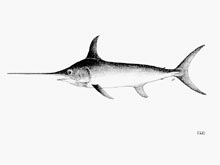
The swordfish is a prize catch for both recreational and commercial fishermen. The Charleston Bump provides valuable nursery habitat, and possibly spawning grounds, for these beautiful fish. Drawing by Robbie Cada, formerly of FishBase.org. Click image for larger view.
Fencing at 550 Meters!
August 3, 2003
Dr. Elizabeth L. Wenner
Research Marine Scientist
Marine Resources Center
South Carolina Department of Natural Resources
The swordfish (Xiphias gladius) is perhaps best known for the thrill that it gives sportfishermen, and as a great entrée on the dinner plate of many restaurant goers. The Charleston Bump actually provides nursery habitat for larval swordfish, and it is thought that spawning may occur in the food-laden waters over the Charleston Bump. Fishermen often target the swordfish that feed in the Bump’s productive waters. Ironically, today’s first sub dive was delayed to allow longline fishermen to pull in their gear.
During the afternoon sub dive, I was riding in the 2-person aft compartment of the Johnson-Sea-Link II submersible. Being in the back of the JSL II is a lot like maintaining a yoga position for a prolonged period -- it is difficult to unfold once you have sat cross-legged for over an hour. I joked to sub crewman Alan Fuller, the other person in the aft compartment, that if I could just throw my legs across his stomach and lie face down, then I would be in the perfect place to turn my head and see out of both portholes. Alan likes to read while in the sub, so I thought he could use my legs as a book prop! Needless to say, he was less than enthusiastic about this prospect.
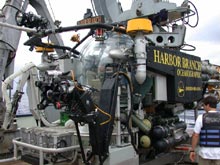
Two people, one pilot and one scientist, can sit up front in the sphere portion of the Johnson-Sea-Link II submersible. Two more contortionists, usually a technician and another scientist, vie for precious space in the aft compartment. Click image for larger view.
As we descended into the depths, I eventually found a comfortable position that provided a good view out the starboard port. Just as we were getting to the bottom, a swordfish darted out of the gloom and shot past the sphere of the sub. Dr. Steve Stancyk, the scientist sitting up front in the sphere, called back to me through his radio headset that he had just seen a swordfish streak past. Given the number of longline boats in the area this morning, we knew that swordfish must be in the vicinity.
As the sub floated along with the current a few feet off the bottom, I marveled at the solitary corals, sponges and bottom fishes living at this depth. Here at 1,800 ft, the landscape is a bit like what I would imagine a moonscape to be. There are spikes of coral, dimples in the substrate, the occasional rock with a fish or crab hiding in its lee. Overall the feeling is peaceful, and I remarked to Alan that it would be so nice just to reach out and touch some of the organisms that were dotting the substrate.
I had little more than spoken these words when I saw a flash of silver out the starboard port. The silver blur struck the JSL II! I moved closer to the observation port and saw a large swordfish, approximately 8 ft long, thrashing and slamming its tail against the sub. It was living up to the "gladiator" part of its scientific name, I thought. In an instant, after thrashing about, it swam a short distance from the sub and gushed a large amount of blood. I was dismayed to see the blood streaming from its mouth and gills. I explained what was happening to Steve and Alan. Alan commented that swordfish have rammed the sub in the past. Possibly, this occurs as a territorial response. Unfortunately, the sub is much larger than the swordfish, and the fish isn’t much of a match for the sub's titanium hull, which is designed to withstand crushing pressure at the depths where it is deployed.
I watched as the swordfish rolled over on its side, its large eye looking at the sub, and, I thought, at me peering out of the port. I felt great empathy for the fish as it continued to spout blood. After a few seconds, it righted itself and slowly swam off into the gloom beyond the lights of the sub. The water around the sub was tinged red, but that quickly dissipated in the half-knot current. I wondered as we continued on our transect whether the fish would recover from its encounter with the sub. I hoped that no mortal damage had been done and that the great fish would not be pursued by other large predators, such as sharks, who stealthily move through these depths in search of food.
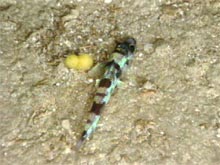
More than 1,800 ft below the sea surface, the lights of the JSL II were probably the first this gorgeous "greeneye" had ever seen. The greeneye is just one of many creatures encountered during our first day diving on the Bump. Click image for larger view.
Regardless of the swordfish's fate, I knew that it would not be wasted. Free falls of food, such as dead fish, are a boon to many organisms in the deep. Deep-sea cameras have documented the swarms of amphipods, hagfish, giant isopods and crabs that move in to take advantage of any large dead organisms that happen to fall to the sea floor. In some instances, scientists have deployed baited traps with attached cameras to document this opportunistic feeding and the organisms that are attracted to the bait. We will be deploying similar carrion traps, plastic buckets weighted with dead oysters. We hope to use the rotting oyster meat to attract motile organisms that are not readily collected by the sub's suction device. We’ll use the sub’s manipulator arm to place two of these carrion traps at the base of rocky ledge habitats. The sub will set another two at the tops of coral mounds.
We are excited about deploying these traps and will report further on their effectiveness to attract deep-sea creatures. Until then, I remain, with bated breath . . .


