


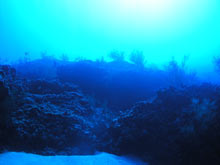
Researchers observed this black coral at 180 ft depth in the Au'au Channel, off Maui, Hawaii. Of the 200-plus black coral species, more than 15 are found in Hawaii. Although found at all depths, black corals can be a dominant feature of Hawaii’s unique deep coral reef environment. Click image for larger view and image credit.
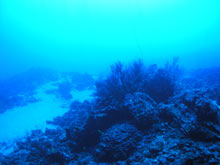
Black coral at 210 ft depth in waters off South Kona, Hawaii. Click image for larger view and image credit.
Black Corals of Hawaii
Anthony Montgomery
Hawaii Department of Land and Natural Resources
Division of Aquatic Resources
Black corals are a group of corals that belong to the order Antipatharia. Black corals are found all over the world and at all depths. Typically, however, they are known as deep-sea corals and can be abundant in certain areas. Black corals are rarely black, but rather vary in color from white to red, green, yellow, or brown. They also range in shape from small bushes to bottle brushes to fans to single stalks. The black corals differ greatly from stony corals in terms of their skeletons. All black corals have a skeleton made of protein and chitin (the same material as an insect skeleton). In addition, black corals do not have symbiotic algae associated with them, and they do not require light which enables them to extend into depths where light is not present.
Of the 200-plus black coral species, more than 15 are found in Hawaii. Although found at all depths, black corals can be a dominant feature of Hawaii’s unique deep coral reef environment. Particularly, black corals are very common in the Au’au Channel, between Maui and Lanai. This unique area has a high abundance of black coral habitat and has been the basis of a coral fishery for almost 50 yrs.
Historically, black coral has been harvested for manufacturing jewelry. The skeleton can be polished to a high luster and used to create beautiful jewelry pieces. In the past, Hawaiians harvested black coral for medicinal purposes.
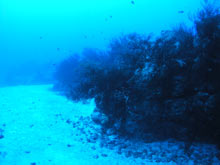
Black coral at 210 ft at Makahuena Point, off Kauai. Click image for larger view and image credit.
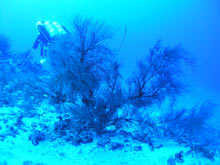
Black coral at 210 ft in the Au'au Channel, off Maui. Click image for larger view and image credit.
The Hawaiian black coral fishery began in the late 1950s and has been active ever since. In 1998, surveys showed the Maui black coral population to be sustainable over the previous 23 yrs. Surveys conducted since this time, however, have shown that the Maui population is undergoing change. There have been two major impacts on the population. One has been the discovery of an invasion of an alien soft coral, called "snowflake" coral, on the deeper portion of the population. A large percentage of black coral colonies below 240 ft have been overgrown by the alien snowflake coral. The second change has been the reduction of larger colonies (greater than 4 ft high) above 240 ft due to fishing pressure. Both of these impacts are believed to be contributing to a reduction of juveniles, which brings into question the future sustainability of the Maui black coral population.
Previous surveys have largely been done by divers using deep mix-gas scuba to reach the population. Although this method can generate the correct type of information to assess the population, it requires people to enter the water and collect population information by hand. This type of methodology, although highly effective, is limited by the amount of time a person can spend on the bottom. To help overcome this limitation, resource managers are interested in looking at new technologies to scan black coral habitat in order to determine the number and size of colonies in a large area.
Operation Laser Line 2006 will test laser line scan technology in order to measure and count colonies on the ocean bottom. If this technology is effective in gathering the proper information, resources managers will be able to use multiple tools to assess the future viability of the black coral fishery.


