




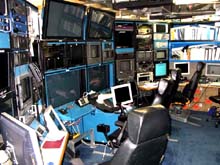
The control room stations (from left): co-pilot, pilot, science, annotation, and navigation. Click image for larger view and image credit.
Behind the Technology
February 2, 2006
Lisa Borok
Web Coordinator
Monterey Bay Aquarium Research Institute
Every morning and evening, a small cluster of us gather to watch the careful choreography of the research vessel (R/V) Western Flyer crew as they deploy and retrieve the remotely operated vehicle (ROV) Tiburon through a door in the ship's floor. None of us seems to tire of watching this "ballet" of hardware and human skill. But that's just the beginning. After observing for the past few days what goes into piloting this Volkswagen-sized sub, I've developed a real appreciation for the teamwork and skill that go into working with this technology.
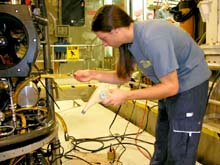
Remotely operated vehicle (ROV) pilot Bryan Schaefer uses a heat gun to repair an electrical cable in the hydraulic system. Click image for larger view and image credit.
Just walking into the control room gives you an idea that this is tricky stuff. Located in the port aft section (that's the rear, left side) of the ship, the control room houses all of the electronics necessary to operate the ROV. Five chairs, each with a microphone headset, are fixed to the floor in front of an eight-ft wall of electronics. Twenty-three monitors and plasma screens flash with vital information. It's not unlike the space center controlling the Mars rovers. The similarity isn't just coincidence. Going deep requires some of the same technology and teamwork as going into space. Both are unforgiving environments that are extremely hard on gear. Make a big mistake and millions of dollars of technology are swept away into the darkness.
The ROV Tiburon's pilots aren't prone to making big mistakes. In 10 years of operation, they've set a high standard for completing missions and keeping the ROV in working order. Each morning, Tiburon is readied to go and fitted with that day's instruments.
During morning launch, the "dance" commences, and Tiburon is lowered via two cranes through the "moonpool" doors in the floor. The R/V Western Flyer rides on two enormous pontoons that keep the deck of the ship 3 m (9 ft) above the churning sea surface. After the ROV splashes down, one of the pilots in the launch bay uses the instrument pack strapped to his waist to "fly" the craft down to about 100 m (300-plus ft) below the ship. At that depth, it's safe to maneuver the ROV to its destination.
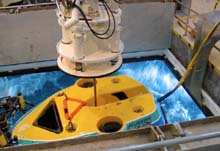
A crane releases the Tiburon through the "moonpool" doors in the launch bay floor. Once free of the crane wire, the yellow "umbilical" cord (at the rear of the ROV) sends and receives electronic and fiber-optic signals throughout the dive. Click image for larger view and image credit.
Once the ROV clears the ship, the crew in the control room takes over from the moonpool team. Scanning the operations from left to right across the five stations, I watch the co-pilot, pilot, science lead, annotator, and navigator swing into the quiet, coordinated action that will continue for the next 10 to 12 hrs.
The co-pilot stays busy observing six different screens and tending several systems at once, including the manipulator arm on the ROV. The pilot's station looks deceptively quiet. There's a lot going on here. With five plasma screens and computer monitors before him, the pilot's main duty is to safely fly the ROV over the sea floor, around walls and outcrops, up and back to points of scientific interest, or straight and level over many meters of transect lines. While keeping the craft on task, the pilot also controls the hydraulic sample drawer, runs the piloting camera and lights, and maintains the delicate balance of distance and direction between the ROV and the ship. The pilot also lines up the still camera to take photos that the science party may want during the dive. It's the pilot who communicates navigation needs to the ship's bridge crew.
The researcher at the science station conducts the overall mission of the ROV for the day. It is the chief scientist who directs the timing and location of collections. Her or she determines the ROV's course and when to pause to look around, zoom in for closer inspection, or run through a transect. The science station has the responsibility of operating the high definition video camera.
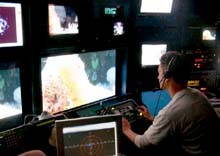
Huff McGonigal takes his turn in the science chair. The large plasma screen in front of him displays high definition video from the ROV. Click image for larger view and image credit.
One of the critical but less glamorous stations is the annotation seat. All dives are videotaped from the time the ROV enters the water to the time it's back on deck. At this station, a science crew member uses a sophisticated database to enter all the highlights of the dive. They can also grab still-images off the video. These notes and images are synched with the time code on the videotape, so we can easily review certain events or views after the dive. This and the data from the ROV are merged to provide a knowledgebase that researchers can "mine" later on.
Finally, in the far corner of the control room, the navigator sits in front of one computer monitor. As Chad King explained in his January 31 log, the navigator's role is to provide compass bearings for the pilot and to plot tracklines, or routes, for the ROV to "fly" along.
This teamwork goes on year-round on the Western Flyer and other oceanographic ships around the world. Our Davidson Seamount expedition will be complete in a few more days, but I will come away with a great respect for the camaraderie and skill involved in ROV-based research.
Sign up for the Ocean Explorer E-mail Update List.


