




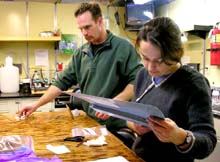
Erica Burton consults the collections protocol guide. Researchers from many institutions have sent guidelines for preserving samples specifically for their work. Click image for larger view and image credit.
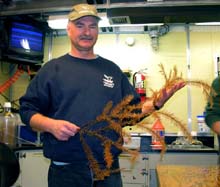
Chief scientist Andrew DeVogelaere holds a black-coral specimen. Click image for larger view and image credit.
Maximizing the Value of Technology
February 3, 2006
Huff McGonigal
Monterey Bay National Marine Sanctuary
Expeditions such as this are not only expensive and resource intensive, but there just aren't many vehicles that can explore places as deep as the Davidson Seamount. We are lucky enough to have one of the most technologically advanced remotely operated vehicles (ROVs) in the world — the Tiburon — at our command. It's important for us to share with others the things we see and collect on the seamount. The British Broadcasting Corporation (BBC) film crew and the Monterey Bay Aquarium Research Institute (MBARI) and NOAA educational efforts are working to ensure that the public has a chance to witness the diversity and abundance of life on Davidson. The science team is working to make sure that we learn as much as possible by sharing the images and specimens that the ROV Tiburon collects.
Before the cruise, we contacted experts from institutions as nearby as Moss Landing Marine Labs (in California) to as far away as the Smithsonian Institute (in Washington, DC) to ask if they were interested in any particular specimens. We had appreciative responses from taxonomists, geneticists, and geologists requesting particular samples that could both further their research and help us better understand the seamount. Their interests include determining the age of the corals, understanding genetic differences between species, and trying to identify new species altogether. While we are exploring the depths, we keep an eye out for what these experts from around the country have asked for. So far, we have collected bamboo, black, and precious coral to send to various laboratories and museums when we return. Along with the frozen or preserved sample, we will also be sending images of the coral in its natural habitat.
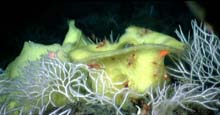
Pandalid shrimps cover a yellow Picasso sponge. The white coral-like animals are not corals, but are probably a new species of the white sponge Asbestopluma. Note the two red laser dots; at 29 cm apart, the dots enable us to make measurements. Click image for larger view and image credit.
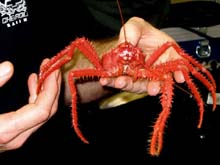
This bright red Lithodid crab is in the same family as king crabs. Click image for larger view and image credit.
In addition to collecting specimens that are on our collection list, we may photograph or take a specimen of other really mysterious deep-sea life we might happen to see during a dive. For example, we've seen some strange sponges that none of the scientists on board could identify, so we photographed them and sent the images to a sponge expert for identification. We also came across another rare find: a female mid-water octopus carrying a clutch of eggs. The ROV delicately scooped it up for identification and study by researchers back on shore.
Sharing the images we take and the specimens we collect helps the whole of the scientific community to better understand the unique ecosystem at the Davidson Seamount. In this way, the full value of the research vessel Western Flyer and the ROV Tiburon can be put to the use that this kind of powerful technology deserves.
Sign up for the Ocean Explorer E-mail Update List.


