






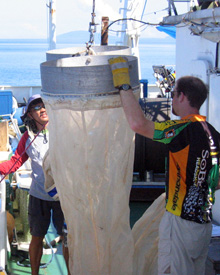
Fig. 1. Val Borja (left) and Nick Loomis, an MIT graduate student, get ready to lift the bongo nets over the side to take a vertical zooplankton sample from 500 meters depth up to the surface. Image courtesy of 2007: Exploring the Inner Space of the Celebes Sea.
Our Cruise to Celebes Sea
October 13, 2007 — Log 1
Valeriano Borja
Marine Biologist
Oceanography Section, Marine Fisheries Research Division
National Fisheries Research and Development Institute (NFRDI)
Bureau of Fisheries and Aquatic Resources Central Office
Joseph Christopher Rayos
Fishery Biologist
NFRDI, Philippines
The National Fisheries Research and Development Institute (NFRDI) assigned us to be two of the Filipino scientists participating in the 2007 Inner Space Speciation Project in the Celebes Sea. Prior to departure we assisted the team in loading and installing equipment. Together with other scientists, we organized the science laboratory, stored shipping boxes and gear in the hold for later use, and decided where to place various pieces of equipment on the crowded aft deck. After much hard work and fine-tuning, we departed Manila for the Celebes Sea on October 1, 2007.
During the cruise we have been observing every activity closely, and we
help with the deployment and retrieval of nets and other samplers and
fill collecting jars for the divers (fig. 1). The remotely operated vehicle (ROV), RopeCam and
video plankton recorder were new to us, but the nets and microscopes are
similar to those that we use in our own marine biology research.
The new technologies and the collection of samples by bluewater diving
that we have seen on this cruise are our windows to discovering what
lives on our ocean floor and in its open waters, revealing life that has
never been seen before.
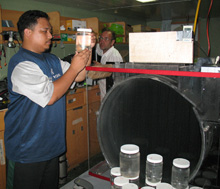
Fig. 2. Joseph Rayos examines a collection jar brought back by the bluewater divers, while Mike Cole (in back) looks on. Large zooplankton and small fishes caught on the dives are carefully transferred from the jars into the planktonkreisel, where the vertically circulating current keeps them in the center for observation and photography. Image courtesy of 2007: Exploring the Inner Space of the Celebes Sea.
We are also collecting phytoplankton samples with plankton nets (1 meter length, 30 centimeter diameter and 20 micron mesh size) that are towed vertically and horizontally. These plankton samples will be shared between the National Museum of the Philippines and NFRDI. They will be analyzed and documented at the NFRDI Laboratory.
The samples we collect on this cruise contribute to our own knowledge in our personal specialties, studies of phytoplankton (Val's specialty) and larval fishes (Joseph's, fig. 2). Through the expertise of the scientists onboard the BRP Hydrographer Presbitero, and the results of our cruise we hope to have considerable success in unmasking the hidden face of the Celebes Sea and in encouraging more collaborative research in this little-studied area of the ocean.


