


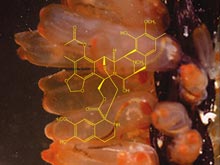
The Caribbean tunicate, Ecteinascidia turbinata, provides a good example of the biomedical potential of marine natural products. This mangrove tunicate produces a novel compound, Ecteinascidin 743, with anticancer activity. The mechanism of action is novel, but poorly understood. Since these small animals lack the biomass to be a sustainable resource, the species is currently the focus of several mariculture ventures. Click image for larger view and image credit.
Drug Discovery in the Twilight Zone
May 28, 2007
Marc Slattery
University of Mississippi
Deb Gochfeld
University of Mississippi
Julie Olson
University of Alabama
NOAA's Office of Ocean Exploration has invested in this expedition not only to explore and describe deep reef communities, but also to determine if any of these uniquely adapted species might represent new biomedical resources from the sea. The ocean is still a largely untapped source of important biotechnology products, and Team Twilight Zone (TZ) is focused on fluorescent proteins, which are useful in biomedical research, and drug discovery efforts. Much of this work will take place back at our home institutions over the next year, although we have already highlighted the preliminary research in Web-logs posted on May 24 (Coral Fluorescence) and May 26 (Predator Deterrence). We have received a few general questions about the drug discovery angle of this research, so we decided to use our Web-log today to give you a peek at the future of “Sponge X,” a hypothetical sample collected by Team TZ on the deep reef this week.
Sponge X was carried back to the Little Cayman Research Center and processed immediately by the members of Team TZ. A sub-sample was fixed in a molecular buffer and in glycerol for microbial characterization and cultivation at the University of Alabama. Voucher specimens, along with photographs, were collected for on-site taxonomic identification, and preserved for follow-up analyses. We also collected a sub-sample for the Sponge Barcoding Project  . Finally we froze the bulk of our sample for transport to the National Center for Natural Products Research (NCNPR) at the University of Mississippi.
Sponge X will be freeze-dried and extracted with organic solvents at the NCNPR. The dried extract will be tested in a number of in vitro (cell-based assays within test-tubes) biomedical assays (e.g., anti-bacterial, anti-fungal, anti-malaria, anti-cancer, and immuno-suppression). Should Sponge X exhibit promising bioactivity, we will begin the process of “bioassay-guided fractionation” to isolate the specific chemical compound(s) responsible for our result. The chemical fractionation techniques are too complex to discuss here, but suffice to say that the extract is ultimately divided into individual compounds, each tested in the original biomedical assay of interest, until a specific biologically active metabolite is identified. In our labs this process takes about three to six months.
Unfortunately, that is just the beginning of the long road to developing a new drug. Assuming Sponge X is an important biomedical lead, we will sign a Memorandum of Understanding with the Cayman Islands government to jointly develop this resource. We will likely start this new venture with a recollection of Sponge X during our second field season, to conduct in vivo (whole organism) biomedical assays. We will also conduct research to enhance bioactivity, decrease toxicity, increase metabolism characteristics, etc.
If Sponge X continues to show promise it will eventually enter clinical trials in humans. However, only about 1 in 100,000 drug leads enters clinical trials, and only 1 in 1,000 ever makes it to the marketplace. While these numbers seem daunting, if one person can be saved from a debilitating disease, then the time has been well spent! Team TZ hopes to make a difference with the unique samples collected during this expedition.


