


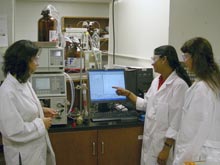
Scientists use a high performance liquid chromatography (HPLC) system to separate pure compounds from sponge extracts. Click image for larger view and image credit.
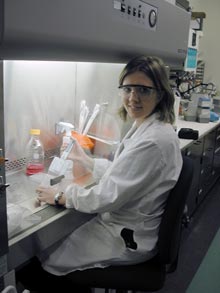
A researcher inoculates extracts into 96-well plates for rapid high-throughput bioassays to determine biomedical potential of sponges. Click image for larger view and image credit.
Mission Summary
Twilight Zone
Drug Discovery, Part II
May 21 – 31, 2007
Marc Slattery
Chief Scientist – Cayman Islands Twilight Zone 2007
University of Mississippi
Deborah Gochfeld
Twilight Zone Expedition Science Team
University of Mississippi
First some background about potential patents: “Intellectual property” loses its value if it is disseminated broadly without legal protection. Thus, the information presented below may appear to be vague, but that is the nature of the beast. . . .
Back in our Ocean Explorer May 27 Web log, we outlined the steps that “Sponge X”— a hypothetical sample from our recent collections in the Cayman Islands Twilight Zone — would take in the long road to becoming a potential new drug. So the question after six months is, What do we now know regarding the biomedical aspects of this project?
In summary, about 100 sponge specimens have been extracted and tested at the National Center for Natural Products Research 
 (NCNPR: Oxford, Mississippi). Those samples have been analyzed for activity against Plasmodium falciparum, the microorganism responsible for malaria . The pathogenic bacteria Eschrichia coli, Pseudomonas aeruginosa, Mycobacterium intracellulare, and a drug-resistant strain of Staphylococcus aureus were also tested, as were three strains of infectious fungi — Candida albicans, Cryptococcus neoformans, and Aspergillus fumigatus. These pathogenic microbes have been targeted since they are common complications for AIDS patients , and typically the infection that causes death in these immune compromised individuals.
Finally, we have developed some proprietary mechanism-based assays (biomedical tests that examine the genetic effects of the analyte) that target cancer and immuno-stimulatory cell function and have run our sponge extracts against these tests. We are currently working with some partner institutions (both academic and industrial) to get these extracts out for additional biomedical testing.
In malaria assays, 29 out of 105 samples advanced to secondary testing, and 8 of those demonstrated significant activity upon retesting to be considered important biomedical leads. While this “hit rate” (essentially 7.6% of the total samples tested) might seem low, consider that the hit-rate for plant samples at the NCNPR is typically less than 1%! In general, marine samples appear to be much more active than terrestrial samples, and our malaria results continue to support this observation.
In the AIDS OI (opportunistic infections) assays (i.e., pathogenic bacteria and fungi), 30 of 105 samples advanced to secondary screening, but none of these were more active than the current medications available so they were not retested. However, 14 of those sponge extracts did demonstrate selective bioactivity against a single opportunistic infection strain, suggesting novel mechanisms of action. These are currently being evaluated for semi-synthetic chemical modification in an attempt to enhance bioactivity.
Previously, we reported increased sample bioactivity with increased depth, and we wanted to assess samples from the Cayman Islands Twilight Zone (TZ) as well. In order to make this claim, we must look at the same species across its depth gradient (i.e., “compare apples to apples”). There were 18 species which were collected above and below the TZ species break at 190 feet (57.9 meters), and in 13 of those species (72.2%) the most active sponges were from the deeper sites. These data are encouraging and suggest that continued focus on the TZ sponges may result in significant biomedical leads.


