


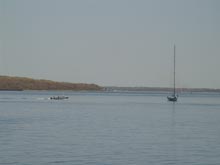
Even in calm weather, autonomous underwater vehicle (AUV) teams are concerned about other users in the area. In this photo, taken during the AUVfest 2008 expedition, a Navy boat approaches a sailboat to inform the sailors that they are in Navy-controlled area and must leave the area. In most places, AUV teams have to politely request that the boat leave the area, or wait for it to move on. Click image for larger view and image credit.
Rough Seas, Currents, and Other Users
May 16, 2008
Charlie Loeffler
Senior Engineering Scientist
Applied Research Laboratories
University of Texas, Austin
 See why rough weather spelled trouble for many AUV systems.
(Quicktime, 1 Mb.)
Early in the AUVfest 2008 mission, rough weather spelled trouble for the autonomous underwater vehicle (AUV) systems. According to Aeorographer’s Mate First Class Eric Glover, who provides meteorological and oceanographical support for this expedition, winds started increasing Monday due to a coastal low-pressure system. Basically, we had a late-season Nor’easter.
Two months earlier, the same system would have produced a good deal of snow. Instead, the system resulted in sustained winds of 25 to 30 knots on Tuesday, with gusts up to 50 knots. The forecast was for seas of 3 to 4 feet, and up to 8 feet at the mouth of Narragansett Bay. In addition to whipping up waves, these systems can disrupt tidal flows, making them harder to predict, and accelerate surface currents.
We always want to get our systems in the water and gather data, but we have to be aware of the conditions at all times. AUVs operate under water, so we are generally not concerned about them completing the mission itself. Most of the time, they are in relatively deep water, where waves don’t affect them too much. If they get in shallow water, though, they can get tossed around, like you would in the surf zone. This can damage their sensors, so we try to avoid getting them in shallow water, especially when the water is rough.
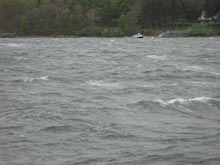
Can you see the AUV in this photo? It’s mostly hidden behind the waves. AUV teams are very concerned about locating their AUVs in rough seas, because the vehicle’s location report is not always correct. Click image for larger view and image credit.
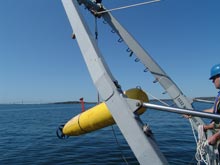
The battleship preparation autonomous underwater vehicle (BPAUV) is lifted by an A-frame and placed in the water during Wednesday’s calm weather. Heavy AUVs that require A-frames for hoisting can weigh 400 pounds or more; and lifting them back onto the rocking boat during rough seas can be extremely hazardous. Click image for larger view and image credit.
Big waves can also be a big problem when it comes to recovery. AUVs don’t sit on top of the water; they are mostly submerged, even when they’re at the surface. So, they can easily be "hidden" behind waves. Although they have communication systems that tell us where they are, sometimes they get the location wrong. It’s also hard for us to hold onto the boat and focus on the AUV during rough weather, making finding them even more difficult.
Once we’ve identified the vehicle, rough water can present another problem when we try to bring it back on board a boat. It can be very difficult to hook the AUV back up to the A-frame, which is used to hoist heavy AUVs (which can weigh 400 pounds or more). With irregular waves rocking the boat back and forth, there is the risk of lifting the AUV at the wrong time and accidentally smashing it into the boat. This can damage the sensors on the AUV, or the AUV itself, or even worse, a person onboard the boat.
In both calm water or rough seas, currents can be a problem. A current can change the course of the AUV, making it miss the target to be mapped. "Fighting" against a current takes up valuable battery power. Even a current moving in the same direction as an AUV can disrupt its operation. A 2-knot current, added to an AUV moving at 3 knots, can cause what we call “holidays.” A holiday is when an AUV’s sidescan sonar, emitting pings of sound from each side and listening for the echo of the sound, misses an area because it’s moving too fast. In AUV-speak, a “holiday” is not a good thing – it’s missing data.
Since Narragansett Bay has strong tidal currents, we have to be aware of what stage the tide is in, and how the current is moving. Everyone wants to put their vehicles in during slack tide, but we can’t put all the vehicles in at the same time. Many of them are mapping the same space, and require space on boats, which we are sharing.
Even when the weather is calm, you can still have hazards, like other users. This week, the AUV teams were watchful of other boats, and didn’t want to run their AUVs near them. In Narragansett Bay, some of the water space is under the Navy’s control. In those areas, the Navy can actually approach a boat and inform the boaters that it is not allowed to be in that space (such as with the sailboat pictured here). In other areas not under their control, the Navy can only ask or politely wait for them to clear the area on their own. Besides mobile users like other boats, AUVs have to contend with stationery gear, like lobster pots and lines. This week, the surrogate safety assessment model (SSAM) vehicle became entangled in a lobster pot line, and had to be cut free by a diver.
Sign up for the Ocean Explorer E-mail Update List.


