


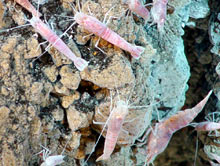
A species of shrimp found on the NW Rota-1 volcano has also been identified at the Loihi seamount, located off the coast of Hawaii. Click image for larger view and image credit.
Biological Studies of the Mariana Arc
Verena Tunnicliffe
Canada Research Chair in Deep Oceans
Professor
University of Victoria, Canada
John Dower
Fisheries Oceanographer
University of Victoria, Canada
Kim Juniper
Biologist
University of Quebec, Montreal
Anna Metaxas
Assistant Professor
Department of Oceanography, Dalhousie University
Biological studies on the Mariana arc during the 2004 and 2005 Submarine Ring of Fire (SRoF) expeditions reveal a multitude of unusual animals and phenomena. Research is focusing on some properties of the volcanic arc vent ecosystem and on the biology of several interesting species.
Biogeography
A major objective of the SRoF'04 expedition was to look at the area's biogeography (the geographic distribution of organisms). We wanted to find out what animals live at arc vents and how they relate to other hydrothermal systems. In 2004, 34 species were identified from the collections of which 14 are new to science. Most are currently under description. For example, several new species of snails were discovered at five volcanoes. Although hydrothermal vents are known to exist at 3,600 m depth (more than 11,000 ft) at the Mariana back-arc spreading center — about 100-plus km (50-plus nautical mi) west of the Mariana arc — few species occur in both places. Depth is a barrier for the swimming larva. Most species appear to occur only in the Izu-Bonin-Mariana arc region. But there are surprises: a shrimp that was very abundant at NW Rota-1 and NW Eifuku is known at only one other location: off Hawaii, over 6,000 km (3250 nautical mi) away, on another volcano. We will continue careful collections on SRoF'06 to augment the distribution and species lists.
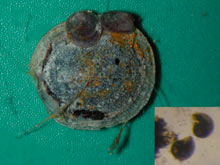
A limpet from NW Eifuku seamount gives two juveniles a free ride. The two larvae hatched from eggs on board the ship (see inset). Click image for larger view and image credit.
Larval Dispersal
How do vent animals on seamounts get around? Plankton (microscopic plants and animals) above vents at deep ocean ridges include 1) dispersing larval stages of vent animals, and 2) a variety of planktonic invertebrates (animals that lack a backbone) that may use suspended food in the hydrothermal plume. At the Mariana Arc, copepods (tiny crustaceans in plankton) were the most abundant near-bottom plankton above the vents. The greatest abundance and diversity of non-vent holoplankton was recorded above vent fields at E Diamante (330 m depth, or 1,082 ft); interestingly, this seamount harbors lush photosynthetic communities at the summit (170 m, or 558 ft). Larvae of vent invertebrates (e.g., snails, clams, worms) are present in low abundance mostly at heights less than 5 m (16 ft) above vent fields.
Bottom samples from E Diamante and NW Eifuku held great abundances of snail juveniles and eggs. Several species lay egg cases on rocks around vents; veligers (a larval stage of mollusk) that hatch from these egg cases remain near the bottom, increasing the probability of their retention within the adult habitat. Such larvae with limited dispersal potential may enhance colonization on these seamounts, where water tends to circulate for many days around the summits. Short-distance dispersal and localized colonization may explain the large variability observed among seamounts in the composition of adult assemblages.
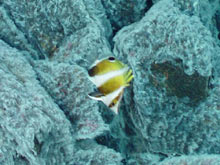
A banded butterfly fish hovers on East Diamante seamount over a white mat of bacterial filaments growing in venting fluids. Click image for larger view and image credit.
Mariana Arc Vent Food Webs
Organic matter produced by chemosynthetic microbes at hydrothermal vents creates a food source used by the vent fauna through the local food web. Since researchers cannot sit and watch what animals are eating, so we use chemical tracers in natural food. Food sources often have unique carbon isotope and lipid "signatures" conserved in the tissues of animal consumers. The nitrogen isotope signature of animals provides information about their trophic level (level in the food chain). By combining information on food sources and trophic level, researchers can interpret vent food-web structure, and how it is influenced by factors such as fluid chemistry and volcanic eruptions.
Analyses of samples from NW Rota-1, where eruptive activity was on-going, revealed a simple food web. The stable isotope analysis of two shrimp species indicates they co-exist by feeding on different food sources (bacteria versus worms) rather than competing for food. At East Diamante volcano — an area shallow enough to reach the photic zone — some animals benefit from food of both chemosynthetic and photosynthetic origin; vent animals receive considerable input from the photic zone. We did see several species of tropical fish from the upper ocean grazing on bacterial mats. We expect to resolve the relative input from these two food sources into the deep corals during SRoF'06.
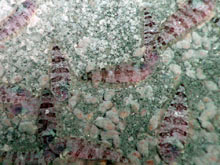
On Daikoku seamount, flatfish are abundant on sediments that also harbor snails feeding on bacterial mats. Click image for larger view and image credit.
The Mariana Tonguefish
During the SRoF'04 cruise, scientists saw dense aggregations of a small flatfish on Kasuga-2 and Daikoku Seamounts. (Flatfish are not part of vent faunas elsewhere.) The fish is a new species, currently under description by Tom Munroe of the Smithsonian. On a second visit to the region with our Japanese colleagues, we collected specimens from Kasuga-2, Daikoku, and Nikkos seamounts. The Nikko flatfish were about twice as large as the flatfish from either Kasuga-2 or Daikoku. Current molecular work (using the Barcode of Life Data System) will determine the relationship among these populations — and verify that they are the same species. We will undertake otolith (tiny head bone that record daily growth) analyses to understand growth rates and age structure. The observed size differences might reflect differences in food availability among the three seamounts, as Nikko Seamount appeared far more productive. However, the smaller fish may represent recent colonization events.
During SRoF'06, we will repeat collections to examine seasonal differences, and we will search for new sites to support studies on population relationships over broad distances. Collection will also support stable isotope work to determine the food sources for these fish. Under the microscope, the sandy sediments from the fish habitat are full of filamentous (threadlike), likely chemosynthetic (able to derive energy from chemicals), bacteria and tiny nematodes (worms). Our current hypothesis is that the fish are probably feeding on both, and thus ultimately supported by chemosynthesis since the nematodes are also likely feeding on the bacterial filaments. Stable isotope and lipid analysis of samples from these "fish spas" are currently underway.
Sign up for the Ocean Explorer E-mail Update List.


