


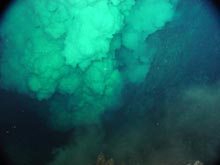
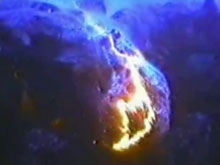
An image taken by ROPOS (the remotely operated platform for ocean science) at the edge of Brimstone Pit near the summit of NW Rota-1 volcano shows ash and sulfur-laden eruptions from the crater. The crater is at a depth of 555 m. The billowing clouds are yellow due to droplets of molten sulfur in the plume bursts. Click image for larger view and image credit.
 Watch an amazing video of smoke billowing from a small crater. (QuickTime,
2Mb)
Watch an amazing video of smoke billowing from a small crater. (QuickTime,
2Mb)
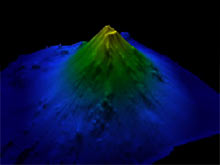
See a virtual-reality animation of NW Rota-1 submarine volcano. (QuickTime, 1.2 Mb)
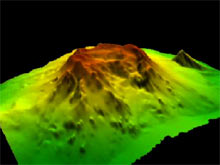
See a virtual-reality animation of the Esmeralda submarine volcano. (QuickTime, 1.9 Mb)
Submarine Arc Volcanism
Bill Chadwick
Geologist
Cooperative Institute for Marine Resources Studies Program, Oregon State University
NOAA Vents Program, Pacific Marine Environmental Laboratory – Newport,
Oregon
This 2006 expedition will continue our exploration of the underwater volcanoes in the Mariana arc, part of the Submarine Ring of Fire that has been virtually unexplored. We will be making dives at new sites as well as returning to some sites visited for the first time in 2004.
Revisiting an erupting volcano!
One of the most exciting parts of our 2004 exploration in the Mariana arc was discovering an erupting underwater volcano called NW Rota-1. At a depth of 550 m, we found a crater we called Brimstone Pit where billowing sulfur-laden clouds burst out of the vent, throwing out ash and lava fragments. This had never before been seen! Even more amazing was the fact that when the site was visited 18 months later in 2005, the volcano was still erupting! In fact, its activity was even more energetic and a 20-m-high cone had built-up over the vent, suggesting that it had been active for much of the time between the 2004 and 2005 observations. Obviously, we are anxious to return there again to see what the volcano is doing now and how its activity is evolving. We also want to sample the lava fragments and the hot fluids coming out of the vent, as well as to re-map the site in order to see how much it has changed since 2004.
Exploring a shallow caldera
An example of a site where we will be diving for the first time is Esmeralda, a shallow submarine volcano that has had several historical eruptions. These episodes were reported by airline pilots who saw areas of "boiling," "steaming," and "bubbling" at the ocean surface and large slicks of discolored water above the volcano. Our mapping in 2003 and 2004 shows that Esmeralda has a caldera (large depression) that is open to the west, with the depth of the caldera floor at about 300 m and the highest point of the caldera rim at only 50 m. We expect to find sea-floor hot springs there and evidence of a very explosive past.
Explosive vs. effusive eruptions
Arc volcanoes on land tend to have explosive eruptions, because the magma (a fluid that cools to form igneous rock) they erupt is relatively viscous (thick) and contains lots of gases. When the magma rises to the surface and the pressure is reduced these gases often escape explosively, much like what happens when a champagne bottle is uncorked. Until our explorations of the Mariana Arc, submarine explosive activity had never been observed, except where volcanoes were very near the ocean surface. That is why we are keen to learn more about the eruptive activity at the submarine volcanoes in the Mariana arc. Their behavior is very different from the style of submarine eruptions on the deep mid-ocean ridge system, where typically only quiet effusive flows of "pillow" lava are produced.
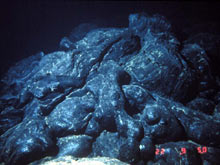
Submarine eruptions at mid-ocean ridges produce fresh lava flows like these "pillow" lavas that form as lava slowly oozes out of a fissure (crack) on the sea floor. These lavas erupted from the southern part of the Juan de Fuca Ridge, lying about 150 mi off the coast of Oregon. This photo was taken about 5 yrs after the eruption. Click image for larger view and image credit.
See
how submarine eruptions form "pillow" lava. (QuickTime, 3 Mb).
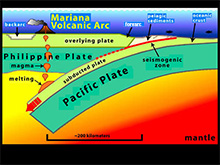
This illustration shows the Pacific plate in the east colliding with the Philippine plate in the west. A consequence of this collision is subduction with the down-going slab comprised of oceanic crust (or lithosphere) and a thin veneer of pelagic (open sea) sediment. This causes extension behind the subduction zone, which is represented by backarc basins forming behind the arc front. At certain depths, usually around 200 km (about 100 nautical mi), there is melting of the subducted materials. The melting produces magmas that rise buoyantly to pond in the overlying mantle wedge and periodically erupt on Earth's surface as lavas, forming arc volcanoes. Click image for larger view and image credit.
Why are these volcanoes there?
The Earth is covered with tectonic plates that are in constant motion over the partially-molten interior. Almost all the volcanoes and earthquakes on Earth occur near the boundaries of these tectonic plates. Where tectonic plates are moving toward each other and colliding, one plate is forced under the other in a process called "subduction." At subduction zones, the down-going plate dives back into the Earth and is eventually melted and recycled. This process causes molten rock to rise back up to the surface to feed chains of active volcanoes called "volcanic arcs." Volcanic arcs can be on land or underwater, or can be a combination of islands and submarine volcanoes, like the Mariana Arc. The "Ring of Fire" is a circular arc of active volcanoes that surrounds the Pacific Ocean basin, mostly above subduction zones.


