


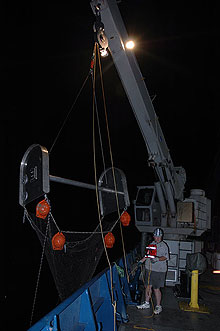
The research vessel (R/V) Atlantis crew gently lifts the first beam trawl of the cruise from the water. A beam trawl is named for the central beam, which connects the two "doors." Click image for larger view and image credit.
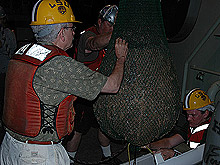
Bob Carney and Matt Kupchik cautiously place a cooler to contain the trawl's muddy catch. Click image for larger view and image credit.
Old-school Sampling
May 12, 2006
Matt Kupchik
Graduate Student
Louisiana State University
26° 43.81 N
092° 49.84 W
In addition to the specialized sampling done on deep submergence vessel (DSV) Alvin dives, Dr. Robert Carney brought along another piece of equipment, a beam trawl. One of the mainstays of sampling in biological oceanography, the beam trawl, has the two "doors" fused at a fixed length with a beam. The trawl we are using on this cruise was designed by Dr. Carney and Innovative Net Systems and fabricated under the direction of Mark Miller of Louisiana State University (LSU) School of the Coast and Environment.
The beam trawl is towed behind the ship and collects organisms living on or just below the surface of the benthos (sea bottom). Since the trawl is towed, it does not sink straight down in the water column. We must extend a much greater length of cable than the water depth. For instance, if the depth is only 2,500 m we may have to extend out almost 4,000 m of cable to ensure the trawl is on the bottom.
Once we lowered the trawl over the side of the ship and into the water, it took almost two hrs to reach the bottom. The four large floats on the top of the net opening keep it open and "fishing" when the trawl is on the bottom. After spending about one hour "fishing" on the seabed, the trawl is hauled back up, and the samples brought onboard by bosun Wayne and the rest of the research vessel (R/V) Atlantis crew. Once onboard, the samples from the beam trawl are sieved to find the organisms in the mud. The samples are then sorted, in some cases dissected, and placed in cold storage until the cruise is over. Holothurians (sea cucumbers) must be dissected and prepped immediately as they tend to disintegrate fairly quickly once removed from the cold high-pressure environment of the deep sea.
One of the things we hope to learn from these trawls is how the seeps influence the ecology of the larger deep sea. Our trawls are targeted at areas near (but not on) seep sites, and we hope to determine if these animals feed on seep productivity. Many of these animals are motile (capable of independent movement), including echinoderms (starfish, sea urchins, and sea cucumbers) and many other taxa. It's not well known if they use the seep sites and associated communities as a source of food, or if they rely on the rain of detritus (loose or decayed material) from the very productive photic surface waters above. Because the seeps have a distinct chemical signature, tissue samples from the animals collected in the trawl can tell you if they have been feeding on seep productivity.
When the cruise is finished, the trawl samples will be taken to LSU and analyzed for a chemical signature using the stable isotopes nitrogen, carbon, and sulfur. By comparison of the isotope ratios for the seep production and the ratios found in the organisms from the trawls, it's possible we can learn what effect seep productivity has on the greater benthic community.
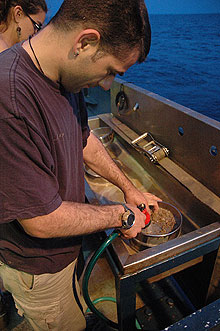
Stéphane Hourdez carefully washes away a few handsful of mud through 2- by 2-mm mesh. He then inspects whatever is left behind, looking for small benthic creatures. Click image for larger view and image credit.
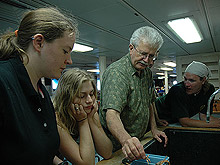
After sorting through the trawl contents and cleaning mud off the ship's back deck, members of the science party gather around while Bob Carney describes the hidden treasures we have captured. Click image for larger view and image credit.
Sign up for the Ocean Explorer E-mail Update List.


