


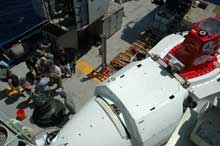
Immediately after exiting the sub, scientists corral the divers to hear more about the discoveries during their eight-hr roundtrip to the sea floor. Click image for larger view and image credit.
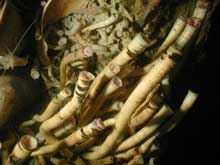
A close-up view of the undescribed Lamellibrachia sp. Several Alvinocaris muricola shrimp are also in this image. Click image for larger view and image credit.
Add Another to the List
May 13, 2006
Stéphane Hourdez
Station Biologique de Roscoff
France
27° 06.32 N
091° 09.96 W
Cold-seep communities harbor some very strange animals. Tubeworms, for instance, lack a mouth, gut, and anus, and rely solely on symbiotic bacteria living within their bodies for nutrition. In comparison to other polychaete annelids (bristle worms), tubeworms are really strange. Tubeworm morphology (structure) is so unusual that experts have had a very hard time classifying them in relation to other animals.
So far, three species of tubeworms have been described from the Gulf of Mexico. Two of the species live at relatively shallow depth, from 457 to 762 m (1,500 to 2,500 ft). Only one lives in deeper waters, down to 3,048 m (10,000 ft).
On two previous cruises, we also collected what we believed to be a fourth species. Unfortunately, we’ve collected only two individuals. This is too few to develop a formal morphological description of the potentially new species.
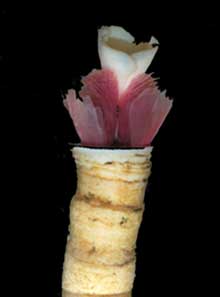
A close-up of the plume of the undescribed Lamellibrachia sp collected during the cruise. The plume consists of the gills and the obturaculum. This specimen will be used to write the formal species description. Click image for larger view and image credit.
On Wednesday, May 10, and again today, the deep submergence vehicle Alvin happened upon groups of this potential new species. The pilots collected enough of the tubeworms for us to formally describe it and explain the variations between it and other tubeworms. The worms are somewhat shorter and bigger in diameter than their relatives higher up on the slope. Their slightly striped tube is also much thicker and harder.
We know it belongs to the genus Lamellibrachia by the presence of lamellae, petal-like structures at the base of the gills. Six other species of Lamellibrachia have been collected and described from various cold-seeps of the world (Japan, the Western Pacific, the eastern coast of the Americas, and the Gulf of Mexico). A seventh species is currently being described from the Mediterranean. This new tubeworm species brings the total number of Lamellibrachia species to eight.
During this cruise, we may still collect yet another brand-new species of tubeworm. We found a few individuals at the shallower sites that we’ve visited in the past. We’re wondering if that species may be more common at deeper sites.
Sign up for the Ocean Explorer E-mail Update List.


