


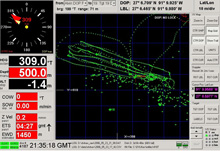
Every movement the deep submergence vehicle (DSV) Alvin makes is recorded by computers on board the ship and on the DSV Alvin itself. This image from the Alvin's navigation shows the sub’s track (in green), after a dive which was partially dedicated to photomosaicking. The close parallel lines are necessary to provide enough overlap in the photos so they can be properly pieced together. Click image for larger view and image credit.
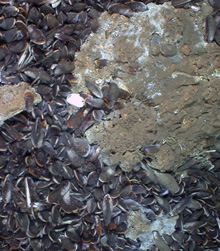
This single image was used in a mosaic of a mussel bed at Atwater Valley Site 340, where extremely dense mussel populations can be found. Bathymodiolus mussels, small tubeworms, and carbonate rocks are common at this site. Click image for larger view and image credit.
Photomosaicking
May 26, 2006
Stephanie Lessard-Pilon
Graduate Student
Penn State University
26 41.15 N
091 39.57 W
In our studies of cold-seep communities, we employ a number of different sampling tools. We use remote sensing to find the sites that we are targeting for our exploration. Once we find the seeps, we take physical samples of the associated animals, microorganisms, sediments, and geological features. In addition, we use two video decks and two digital still-cameras that record constantly, as well as several others that are available when needed. These provide large amounts of imagery rich in ecological data on the seep habitats and fauna. To help us understand particular sites in greater detail, we use photomosaics to provide a high resolution image of much larger areas than can be covered in a single photograph.
A photomosaic is a compilation of a series of overlapping photographs into a single large image. A high resolution down-looking camera is mounted on the deep submergence vehicle (DSV) Alvin. The camera is inside a special water-tight and pressure-safe housing. It is set to take pictures automatically, every 10 seconds. The submersible pilot carefully maneuvers the submarine back and forth over the target area, taking lines of overlapping images of the ocean floor. After the dive, the pictures are downloaded and overlapping images are seamlessly "blended" together using software designed by scientists at the Woods Hole Oceanographic Institute. The resulting mosaic covers 100 or more square meters, but retains the resolution needed to identify most of the species in the images.
The location of the submersible on the ocean floor is carefully monitored, and coordinates for every spot where the DSV Alvin took a picture are recorded. This helps place the photomosaics within a geographic information system (GIS) framework.
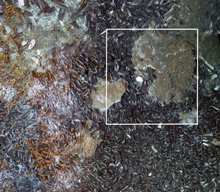
This photomosaic is a careful compilation of multiple images of a mussel bed taken with the downward-looking still camera on the DSV Alvin. This is only a small piece of the entire mussel mosaic. The white box shows the single image also included at the beginning of this log. Click image for larger view and image credit.
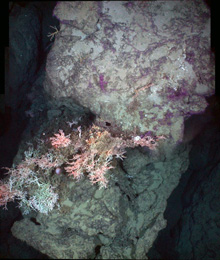
This line shows four images blended seamlessly together using software designed by scientists at Woods Hole Oceanographic Institution. The pictures show Madrepora coral with a sea star and purple sponges on carbonate boulders. The images for the larger photomosaic of the Coral Garden site were particularly difficult to capture. Strong currents continuously buffeted the sub making it difficult for the Alvin pilots to "fly" in the desired pattern. As you can see in this small piece, their perseverance paid off. Click image for larger view and image credit.
We can then create digital layers in the GIS that show the locations of all the different species of animals and kinds of substrate in the images. Using GIS software, we can quantify and identify the animals in the image and test hypotheses concerning the habitat they prefer, or species they associate with. The photomosaics also provide a detailed map of the community structure at a distinct moment in time. When we return next year, we can photomosaic the same site to see how the communities change over time.This approach is invaluable to help us describe these communities and understand the basic interactions among these animals and their environment. And all this will be accomplished without collecting a single animal or disturbing the community in any way!
Sign up for the Ocean Explorer E-mail Update List.


