






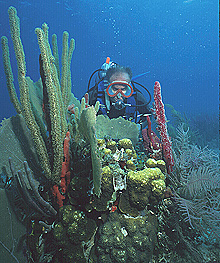
A typical Caribbean shallow-water "patch reef" of massive hard corals, soft corals, and sponges. Hard corals like these can form huge reef structures, such as the Belize Barrier Reef. Click image for larger view.
Coral, Ecosystems, and Climate:
Can Ancient Corals Tell the Story?
Fred Andrus
Department of Geological Sciences
University of Alabama
Coral has long attracted the attention of scientists. It is an interesting organism with an equally interesting ecology. Coral reefs represent some of the most diverse, complex, and fragile ecosystems in the world. Ecological and climatic variables, such as nutrient availability and water temperature, significantly influence coral growth.
Much of the coral research today focuses on understanding how coral grows, how coral interacts with other organisms, and the ways in which human activity affects the health of coral reefs. Another important but lesser-known avenue of investigation is studying the ways in which corals act as “recorders” of the world around them as they grow. The calcium carbonate skeleton that the organism leaves behind contains evidence of these environmental variables that affect the coral's growth. Ancient coral can, therefore, contain information about ancient climate and ecology.
Skeletons leave a record of growth
Corals are actually very small, soft-bodied organisms that secrete the
hard skeletons we see. As corals grow, they leave behind
their old skeleton and grow a new skeleton on top of it. The
old skeleton is preserved underneath the living coral,
leaving a record of growth. Shallow-water
corals often create vast reefs as they grow, with the
help of symbiotic algae and tropical sunlight. Deep-water
corals produce much less skeleton and survive in the cold, dark water by
feeding on passing nutrients.
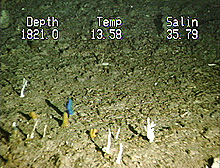
Small coral colonies such as these are typically found on hard-bottom areas of the Blake Plateau, which lie under swift Gulf Stream currents. The chemical composition of these small, hard corals, along with surrounding coral rubble and fossil corals, can reveal a history of temperature changes on the Blake Plateau. Click image for larger view.
Corals that grow on reefs in shallow tropical water are relatively easy to visit and study, but deep-water corals are far more difficult to observe. Even simple measurements like growth rate are comparatively hard to make.
Growth rate is a critical variable in our understanding of coral ecology. By measuring growth rate, we can unlock what coral can teach us about past climates. (Also, deep-water corals are now being impacted more and more by human activity. It is, therefore, increasingly important that we understand how our actions may affect these organisms.) Since we cannot directly observe deep-water coral growth in their natural habitat for long periods of time, we must use other methods to determine growth rate. One way might be to mark the size of a coral (without damaging it), leave it alone for a period, then return to see how much it has grown.
Fortunately, corals leave behind their own marks as they grow, in much the same way as trees. To make use of these growth marks, or "increments," we must determine what length of time they actually represent. Once we know that, determining growth rate is fairly simple. (Unfortunately, this method is not practical for deep-water corals.)
Unlocking a chemical portrait
One method we use to determine incremental growth rate is the analysis of chemicals locked in the coral
skeletons. Some aspects of coral chemistry are controlled
by variables like water temperature. In
some deep-water environments, such as the Charleston
Bump, temperature varies over time throughout the year.
Therefore, the chemistry of the skeleton may record
the time of the year and permit us to measure how fast these corals grow.
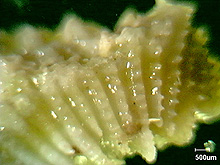
Scientists can cross-section small coral fragments and look for visible lines that indicate growth. We can relate these lines to changes in chemical composition and determine if changes in growth rates are linked to water temperature. Click image for larger view.
We have observed many different coral growth patterns on the Blake Plateau. Hard surfaces are often covered, to one degree or another, with small “twigs” of coral, each only a few centimeters high. Some areas have many of these corals packed tightly together, while other areas have only a few widely scattered corals. In a few areas, large tangles of corals that resemble bushes cover the bottom. Other areas have no corals at all.
None of these patterns are likely to be random, and by simply knowing how fast these corals grow, we may be able to determine the most important factors that control the formation these different growth habits.
The uncertain future
An unfortunate variable
that impacts deep-water coral growth habits in other parts of the world
-- but not the Blake Plateau -- is the use of fishing methods that destroy large areas of coral as dredges and other
equipment are dragged across the bottom. How fast can coral recover
from these disturbances? When will the ecosystems within which
the corals live return to these areas after they are destroyed? Simple
age measurements are critical to answering these questions and understanding these processes.
Some areas we have visited on other expeditions contained the skeletons of corals that appeared to have died some time ago. By studying the chemical records in these older corals, we hope to unlock clues about the ecosystems and climates of the times in which these corals lived. These long-dead corals may give insight into how the local and global climate has varied over time. Much of what is known about past climates is derived from records trapped in shallow tropical corals. Deep-water corals may contain a similar record of change.


