


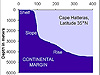


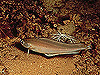


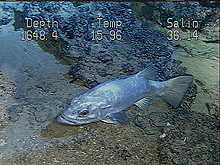
The wreckfish (Polyprion americanus) is a large, slow-growing, deep-water fish. Currently, commercial fishermen catch this fish on the Blake Plateau. Click image for larger view.
Expanding Fisheries and Fishery Potential on the Blake Plateau
Kelly Filer
Graduate Student
College of Charleston
Commercial fisheries have traditionally been based on fast-growing shallow-water species that live in the productive waters on the continental shelf. More recently, as fishing technology has improved and the populations of shallow-water species have declined, fishermen have ventured out into deeper waters to find new types of fish to catch.
This new deep-water fishery presents a problem for fisheries management. The deep-water fish are larger than their shallow-water counterparts and often grow more slowly. Most management models, however, are based on data pertaining to the smaller, faster-growing species. To ensure that the deep-water fisheries will be around for a long time, fisheries scientists are developing new models that take into account the longer life spans and the longer period it takes for these deep-water fish to reach sexual maturity.
Wreckfish management shows promise
Some larger, slower-growing fish populations are being managed with apparent success. The North Atlantic wreckfish (Polyprion americanus) is one such example. In the mid-1980s, a
few commercial fishermen started catching the wreckfish in areas around
the Charleston Bump, a rocky outcropping on the continental slope off
the coast of South Carolina. The South Atlantic Fishery Management
Council soon began formulating a plan to manage this growing fishery. Creating this plan was initially difficult, however, because information
on the biology of the wreckfish was scarce.
Today, the wreckfish management plan includes a total allowable catch (TAC) that limits the amount of fish that can be taken by the fishery, an individual transferable quota (ITQ) that limits the landings of each fishermen, restrictions on the types of gear that can be used, and closing of the fishing grounds during the main spawning season (January 15 through April 15).
Still, there are challenges.
Two characteristics of the wreckfish make conservation and management difficult. One is that the wreckfish migrates throughout the North Atlantic during its life cycle; and the other is that all of the wreckfish in the North Atlantic (from Europe and America) seem to come from a single population. Nations on both sides of the Atlantic must work together to ensure that the population remains large enough to support a fishery. Historically, the species has suffered in the hands of industry. The high fishing pressure on the wreckfish around Bermuda, for instance, caused its commercial extinction in those waters in the 1980s. U.S. management policy is aimed at preventing that from happening here.
Scientists also worry about the problem of bycatch (unintentional catching of one species when fishing for another) of both adult and juvenile wreckfish. For example, the juveniles are often caught in tuna nets in the eastern North Atlantic. This could have serious effects on that population since the younger fish would never mature to produce more fish. All of these issues must be considered when determining the best way to manage the wreckfish. To date, the restrictions set in place have helped to keep this population size at a constant, which gives hope to those trying to manage potential fisheries for other deep-water species, like the barrelfish (Hyperoglyphe perciformis) and the red bream (Beryx decadactylus).
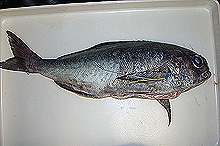
A specimen of barrelfish (Hyperoglyphe perciformis). We are trying to learn more about the biology of this fish to determine if it can support a fishery on the Blake Plateau. Click image for larger view.
Barrelfish may become popular
Like the wreckfish, the barrelfish is a relatively large and probably long-lived, deep-water fish. Only the adults are found around
the Charleston Bump area; the juveniles apparently live elsewhere.
We know little about the barrelfish, but we believe it may move about the North Atlantic like the wreckfish. Barrelfish are found throughout the North Atlantic (sometimes in different life stages), but only large adults are found in the western North Atlantic off the coast of South Carolina.
We are in the process of trying to understand the general biology of the barrelfish, such as how long they live and when they mature. Most barrelfish are caught on the Blake Plateau as bycatch of the wreckfish fishery. However, like the wreckfish in the 1980s, the barrelfish may rapidly become popular. We are already beginning to study this fish so that we will have data to develop a management plan, if necessary. Some of the strategies in place for the wreckfish fishery may apply to the barrelfish, as well.
The red bream shows commercial potential
The red bream (Beryx decadactylus) is another species with commercial
fishery potential on the Blake Plateau. We know very
little about its life cycle. In the Canary Islands and
off the coast of Portugal, the fishing pressure on red bream (and the
only other member of the genus, Beryx splendens)
has caused the annual catch to decrease in recent years. The same
thing is happening in other areas where Beryx species are being
fished, such as Hawaii.
Wreckfish fishermen do catch red bream from the waters over the Blake Plateau, though not much information is available on exactly where in the water column it lives. In the Canary Islands, red bream live in water 400-800 m deep. Some research indicates that red bream move to deeper waters as they grow and that spawning occurs, at least for the population in the eastern North Atlantic, around the Canary and Madeira islands. They probably do not migrate around the North Atlantic, as do the wreckfish. The red bream does, however, appear to be a long-lived, deep-water species.
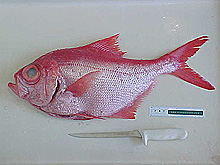
The red bream (Beryx decadactylus) supports fisheries in parts of the North Atlantic and may have commercial fishery potential on the Blake Plateau. Click image for larger view.
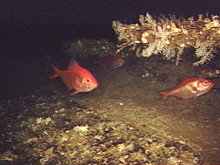
The red bream (Beryx decadactylus). Click image for larger view.
The information obtained from the wreckfish, together with what we learn about the barrelfish during this expedition, may help us manage the red bream on the Blake Plateau -- even before we have the chance to learn all we can about this fish.
Deep-water commercial fisheries will continue to grow. Since models for management plans for shallow-water species do not translate to these new target species, fisheries scientists must continue to learn as much as they can about these deep-water fish in order to preserve large stocks for future generations.


